
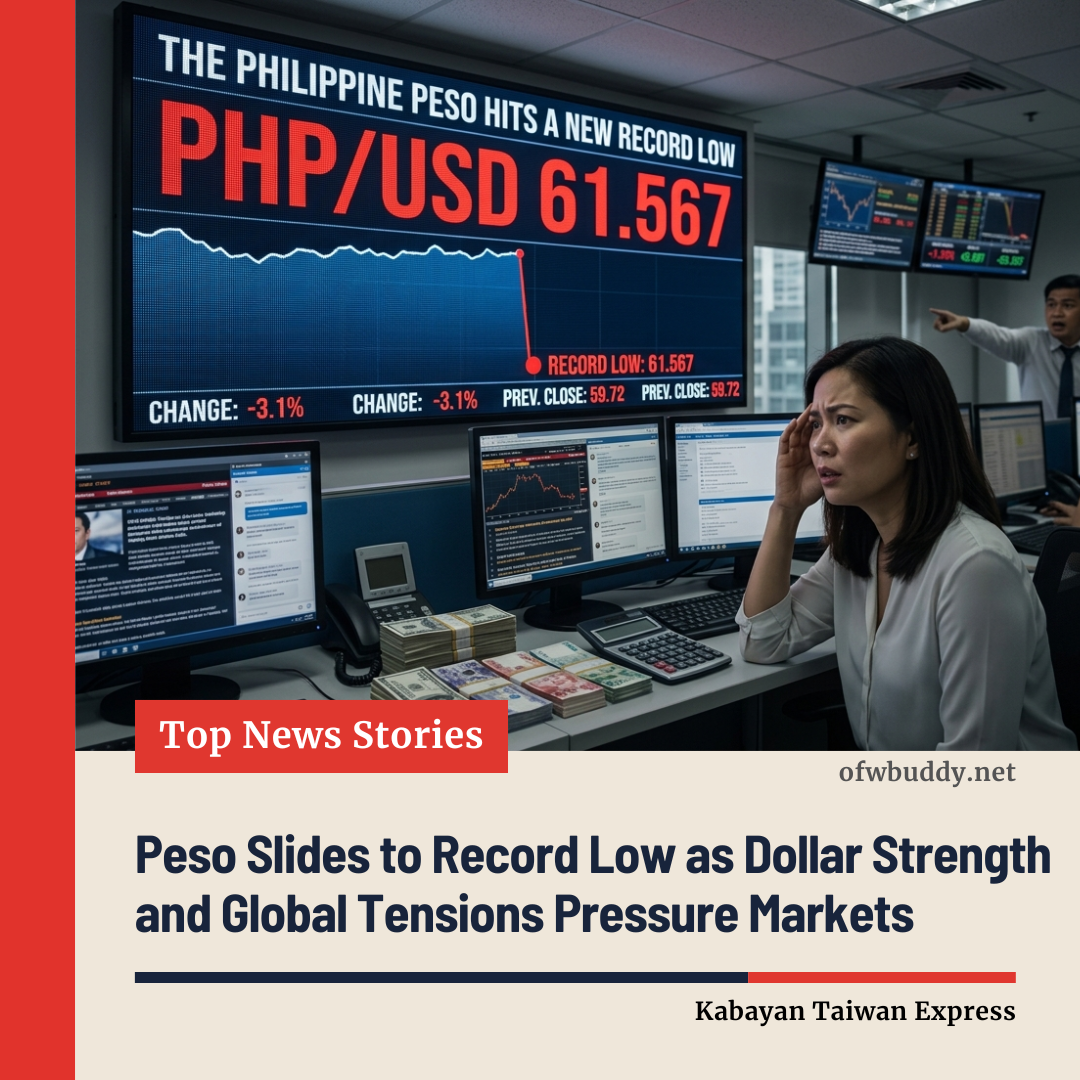
Manila, Philippines (April 30, 2026)— The Philippine peso weakened further on Wednesday, breaking past the 61-per-dollar level and marking another record low amid a stronger US dollar and continued global uncertainty driven by geopolitical tensions in the Middle East.
The local currency closed at 61.567 against the US dollar, depreciating by 26.7 centavos from the previous session, according to data from the Bankers Association of the Philippines. During intraday trading, the peso even touched 61.67, before slightly recovering toward market close.
This latest decline surpassed the previous record low of 61.3 recorded just a day earlier, reflecting sustained pressure on emerging-market currencies as investors continue to favor safer assets like the US dollar.
Dollar Strength and Global Risk Sentiment
Market sentiment has been heavily influenced by expectations surrounding the US Federal Reserve’s upcoming policy decision. The dollar strengthened as investors anticipated that interest rates in the United States would remain unchanged, with markets closely watching signals from Fed Chair Jerome Powell on future policy direction.
Analysts noted that geopolitical risks, particularly ongoing tensions in the Middle East, have increased demand for safe-haven assets, further supporting the US dollar’s strength.
Local Market Conditions
Trading activity in Asia remained relatively thin, with volume slipping to $1.6 billion from the previous $1.7 billion. Holidays in key markets, including Japan, also contributed to reduced liquidity.
Despite a recent policy move by the Bangko Sentral ng Pilipinas (BSP) to raise interest rates by 25 basis points to 4.5%, the peso continued to weaken. The BSP described the move as preventive, aimed at managing inflation risks linked to global uncertainty and rising oil prices.
Economic Impact
A weaker peso has mixed effects on the Philippine economy. Overseas Filipino workers benefit from higher peso value for remittances, and exporters gain improved competitiveness in global markets. However, the depreciation also raises concerns about imported inflation and increases the cost of servicing foreign currency debt.
Market Outlook
Analysts expect continued pressure on the local currency in the near term. Some forecasts suggest the peso could test the 62 to 62.50 range, depending on global developments and oil price movements.
While the BSP has stated it does not target a specific exchange rate level, officials have indicated they may step in to stabilize the market if currency movements become too sharp or disorderly.
As global uncertainties persist and US monetary policy remains in focus, the peso is expected to remain under close watch in the coming weeks.