
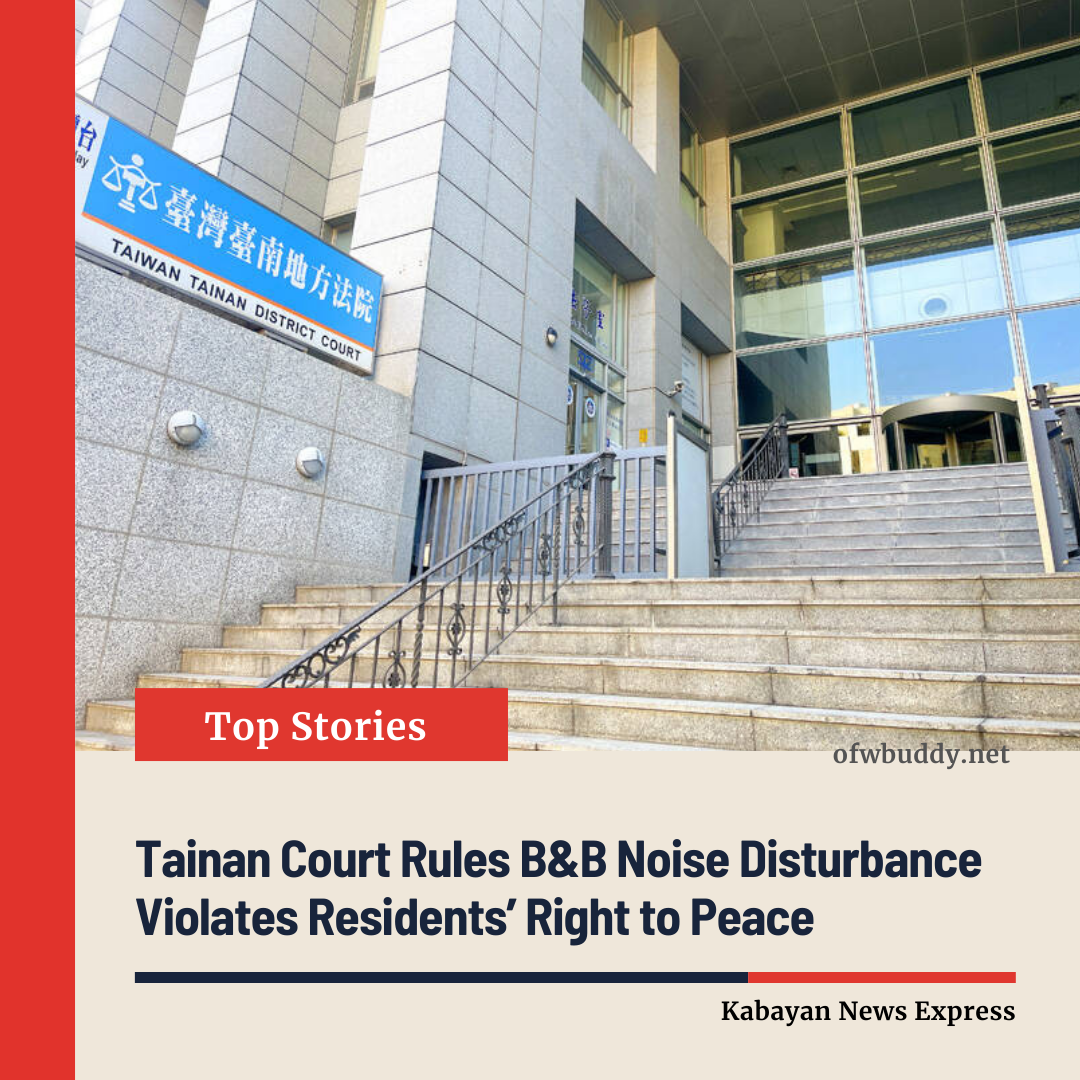
Tainan City, Taiwan — February 2, 2026 — A bed-and-breakfast operator in Tainan has been ordered by a court to compensate nearby residents after repeated noise disturbances disrupted the neighborhood’s peace, underscoring that excessive noise can constitute a violation of residents’ legal rights.
The court ruled that the operator must not only pay damages but also strictly comply with statutory noise control standards. Legal experts noted that Taiwan’s Supreme Court has long recognized the “right to residential tranquility” as part of an individual’s personal rights protected under civil law.
Attorney Shih Chih-yuan explained that when noise exceeds what an average person can reasonably tolerate in daily life, it may be deemed an infringement of personal rights, making the noise producer liable for damages. He emphasized that residents affected by noise should carefully document evidence, including the time, location, and decibel levels of the disturbance, preferably using professional equipment such as sound level meters when necessary.
Shih added that evidence showing the continuity of the noise is particularly important. Courts are more likely to be persuaded if recorded noise levels exceed administrative limits set for different zones—such as residential or commercial areas—and for different time periods, including daytime or late-night hours.
Under Article 72 of Taiwan’s Social Order Maintenance Act, individuals who create disruptive noise may face fines. Residents experiencing noise disturbances can gather evidence and file complaints directly with local police authorities.
Police and Environmental Authorities Empowered to Act
According to the Tainan City Environmental Protection Bureau, noise generated by activities in residential B&Bs often lacks continuity or is difficult to measure precisely. Under Article 6 of the Noise Control Act, such disturbances are handled by the police rather than environmental authorities. Police may impose fines of up to NT$6,000 on those responsible for disturbing public peace.
Additional penalties may apply under the Condominium Administration Act. Article 16 prohibits residents from engaging in loud, disruptive, or vibration-causing behavior. If such conduct violates registered community regulations, local authorities may impose fines ranging from NT$3,000 to NT$15,000, order corrective actions within a specified period, and issue repeated penalties if compliance is not achieved.
Tourism Authorities May Impose Separate Penalties
The Tainan City Tourism Bureau stated that under the Regulations for the Management of Home Stay Facilities, B&B operators who generate noise that affects surrounding residents may be penalized after fines are issued under the Social Order Maintenance Act or the Noise Control Act. In such cases, the tourism authority may additionally impose an administrative fine of NT$10,000 in accordance with the Tourism Development Act.
The case serves as a reminder to accommodation operators that maintaining neighborhood peace is not only a matter of courtesy, but also a legal obligation with potential civil and administrative consequences.